

- About TCB
- Sewing Machines for TCB
- TCB Crews Introduction
- News / Daily
- Shop / Stockists
- Repair & Hem
- Recruit
- Contact


2026/09/10
昨日は、Vintageの大戦モデルとLate S40’sを並べ、その色の落ち方を比較しました。
二本の表情が驚くほど似ていたことが、素直に嬉しかった。
その色落ちに改めて感動した私は、Late S40’sの生地を織っていただいている井原の織物工場へ、力織機G3を見に行ってきました。
Late S40’sの生地を作るときに想像したのは、大戦時の混沌とした時代です。
産地も品質も異なる綿が寄せ集められ、一生懸命きれいな糸を作ろうとしても、きっと均一にはならなかった。
太さも形も揃わず、一つの番手には収まらないムラ糸になったのではないか。
そんな妄想から、Late S40’sの経糸には7.5番手と6.5番手、二種類の糸を作って使っています。
違うのは、糸の太さだけではありません。
7.5番手と6.5番手、それぞれで糸の形状まで変えています。
レシピだけを並べてもワクワクする生地ですが、それを一枚のデニムとして織り上げるには、井原の職人さんの力が必要です。
私はミシンに置き換えると、少し理解しやすくなります。
例えば20番手の糸で縫うなら、ミシンを20番手用にセッティングすれば、気持ちよく縫うことができます。
でも今回のお題は、7.5番手と6.5番手という性格の異なる糸を、一つの生地の中に混ぜること。
7.5番手だけに合わせても駄目。
6.5番手だけに合わせても、うまく織ることができません。
二つの糸の間を探りながら、その日の気温や湿度、機械の調子まで読み取り、少しずつG3を調整していく。
数値やレシピだけでは辿り着けない、最後は職人の経験と勘に委ねられる部分が大きいのだと思います。
目の前でLate S40’sの生地が織られていく姿を見ていると、これまで以上に、この生地を大切にしたいと感じました。
もちろん、この力織機はもう生産されていません。
一台のG3をこれからも動かし続けるため、工場の外には、部品を取るための古い力織機が並んでいます。
役目を終え、錆びながら次の一台を支える力織機。
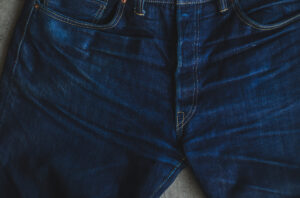
その姿にも敬意を込めて、私物のLate S40’sに、この場所の錆を少し分けてもらうつもりで記念撮影しました。
G3と、このG3を守り続ける職人の皆さん。
これからも、どうぞよろしくお願いします。
Yesterday, I placed a vintage WWII-era model alongside our Late S40’s and compared the way the two pairs had faded.
Seeing just how similar their expressions had become made me genuinely happy.
Inspired all over again by the fading of the Late S40’s, I visited the weaving mill in Ibara where its denim is made, to see the G3 shuttle loom in action.
When we began developing the fabric for the Late S40’s, I imagined the chaos of the wartime years.
Cotton of different origins and varying qualities would have been gathered together. Even if the spinners had tried their hardest to produce a clean, consistent yarn, it probably would not have come out perfectly uniform.
The yarn would have varied in both thickness and shape, refusing to fit neatly into a single yarn count.
That idea—or perhaps that fantasy—led us to create two different warp yarns for the Late S40’s: a 7.5-count yarn and a 6.5-count yarn.
The difference is not only in their thickness.
We also gave the 7.5-count and 6.5-count yarns different profiles and characteristics.
The recipe alone is enough to excite me. But turning that recipe into a single piece of denim requires the skill of the weavers in Ibara.
For me, it is easier to understand if I compare it to a sewing machine.
If you are sewing with No. 20 thread, you can set the machine specifically for that thread and it will sew beautifully.
But our challenge this time was to weave two yarns with very different characteristics—the 7.5-count and the 6.5-count—into a single fabric.
A setting suited only to the 7.5-count yarn will not work.
Neither will a setting suited only to the 6.5-count yarn.
The weaver must find the balance between the two, reading the temperature, humidity and condition of the loom that day, then gradually adjusting the G3.
Numbers and recipes can only take us so far.
In the end, much of it comes down to the experience and intuition of the person operating the loom.
Watching the Late S40’s denim being woven before my eyes made me appreciate the fabric even more.
These power looms, of course, are no longer being manufactured.
To keep a single G3 running far into the future, old looms stand outside the mill as donor machines, providing the parts needed to keep another one alive.
Their own work may be finished, but even as they rust, they continue to support the next machine.
Out of respect for them—and with the thought of letting my own Late S40’s borrow a little of the rust from this place—I took a commemorative photograph.
To the G3, and to the craftspeople who continue to keep it alive:
Thank you, as always.








 Categolies
 Tag
Tag Archive