

- About TCB
- Sewing Machines for TCB
- TCB Crews Introduction
- News / Daily
- Shop / Stockists
- Repair & Hem
- Recruit
- Contact


2026/09/08
このカバーオールは、ヴィンテージのカバーオールを、そのまま再現したものではありません。
元になったのは、私が所有するLeeのUNION-ALLS。
その上半身をよく見ると、同年代の非常に希少なチンストラップ付きLeeカバーオールと、驚くほど多くの共通点がありました。
もし、このUNION-ALLSから上半身だけを切り出したら。
そこから、Chopped Coverallの製作が始まりました。
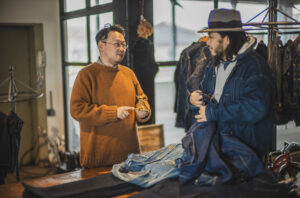
TCBのプロジェクトは、私がヴィンテージを専務に見てもらうところから始まります。
二人で服を表から、そして裏から眺めながら、必要なミシンの設定やアタッチメント、糸の種類を一つずつ洗い出していきます。
今回のChopped Coverallが通常のカバーオールと大きく異なるのは、元がツナギであるため、ちょうど腰に当たる部分に横方向の接ぎが存在すること。
表側だけを帯状に見せて、デザインとして再現することもできます。
しかしTCBでは、実際のツナギと同じ縫製仕様で仕上げました。
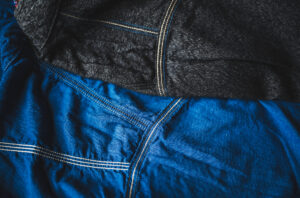
ヴィンテージを裏返してみると、腰部分の上下にはチェーンステッチ。
さらに、その上をトリプルステッチの巻き縫いが走っています。
合計、5本のチェーンステッチ。
Chopped Coverallをひっくり返しても、同じように5本のチェーンステッチが現れます。
表から見ただけでは分からない部分ですが、この服が単なる「カバーオール風」ではなく、UNION-ALLSの上半身から生まれたことを示す、大切なディテールです。
もう一つ、ヴィンテージらしい部分があります。
当時のミシンには、現在のような自動糸切りの機構がありません。
そのためポケットの裏側を見ると、フラップを縫ったときの糸が、そのまま切られずにつながっています。
古いワークウェアではお馴染みの仕様ですが、Chopped Coverallでも、その姿まで再現しました。
そして、もう一つ面白いのがボタンホールです。
リーチンのチンストラップを留めるボタンホールと、身頃に並ぶボタンホールでは、形状が異なっています。
一番上、台襟部分に使われているのは、シャツなどで見られる「眠り穴」、あるいは「71ホール」と呼ばれる形。
それより下には、Gジャンやカバーオールでお馴染みの「流れ鳩目」、あるいは「99ホール」と呼ばれるボタンホールが使われています。
なぜ、ここだけ使い分けられているのか。
台襟には段差があるからなのか。
それとも、当時の工場に並んでいたミシンや、縫製工程の都合だったのか。
答えは一つではないのかもしれません。
そんなことを想像しながら、ヴィンテージを裏返し、当時のミシンのラインナップや縫製工程について専務と話す。
製品になる前の、私にとってとても楽しい時間です。
Chopped Coverallには、その時間の中で見つけた答えが、表から見える場所にも、見えない裏側にも残っています。
This coverall is not a straightforward reproduction of a vintage coverall.
Its origins lie in a pair of Lee UNION-ALLS from my own vintage collection.
When I took a closer look at the upper half, I discovered that it shared a surprising number of details with the extremely rare Lee coveralls from the same era featuring a chin strap—often referred to in Japan as the “Lee Chin.”
What if we cut away the lower half of these UNION-ALLS and turned the upper half into a jacket?
That was where the Chopped Coverall project began.
At TCB, every project begins with me showing a piece of vintage clothing to our managing director.
Together, we examine it from the outside and then turn it inside out, identifying the necessary sewing machines, machine settings, attachments, and threads one by one.
What makes the Chopped Coverall fundamentally different from an ordinary coverall is the horizontal seam around the waist—a detail that exists because the original garment was a pair of coveralls.
We could have simply added a band of fabric to the outside and reproduced the appearance as a decorative detail.
But at TCB, we constructed it using the same sewing specifications as the original UNION-ALLS.
Turn the vintage garment inside out and you will find chain stitching along both the upper and lower edges of the waist seam.
A triple-needle felled seam also runs across it.
Five lines of chain stitching in total.
Turn the Chopped Coverall inside out and you will find the same five lines of chain stitching.
It is a detail that cannot be fully appreciated from the outside, but it is also proof that this garment is not merely designed to look like a coverall. It was genuinely developed from the upper half of a pair of UNION-ALLS.
There is another distinctly vintage detail hidden inside the garment.
Sewing machines of that period did not have the automatic thread-trimming mechanisms found on modern machines.
As a result, when you look behind the pocket, you can see that the thread used to sew the flap was left connected rather than being cut.
It is a familiar sight on old workwear, and we reproduced even this small detail on the Chopped Coverall.
Another interesting feature is the buttonholes.
The buttonhole used to fasten the chin strap on the “Lee Chin” has a different shape from those running down the body.
The uppermost buttonhole, positioned on the collar stand, is the straight style commonly used on shirts. In Japanese sewing factories, it is often called a nemuri-ana, or “71-hole.”
The buttonholes below it are the keyhole-style type familiar from denim jackets and coveralls. These are known in Japanese factories as nagare-batome, or “99-holes.”
Why were two different types of buttonholes used on the same garment?
Perhaps the buttonhole on the collar stand was treated differently because of the uneven layers and thickness of the fabric.
Or perhaps it was simply determined by the sewing machines available in the factory at the time, or by the order in which the garment moved through the production line.
There may not be one definitive answer.
But imagining the reasons, turning the vintage garment inside out, and discussing the machines and sewing processes of the period with our managing director is one of the most enjoyable parts of making clothes for me.
The answers we discovered during those conversations remain in the Chopped Coverall—in the details you can see from the outside, and in those hidden beneath the surface.



 Categolies
 Tag
Tag Archive