

- About TCB
- Sewing Machines for TCB
- TCB Crews Introduction
- News / Daily
- Shop / Stockists
- Repair & Hem
- Recruit
- Contact


2026/09/07
私が約1年半穿き込んだ、20’s Jeans。 完成した直後から穿き始めた一本です。 このジーンズを作るとき、参考にしたヴィンテージを眺めながら、ふと気になったことがありました。 かなり色が落ちた個体なのに、レザーパッチが硬化せず、まだしなやかに残っている。 一方、1940年代後半のジーンズを見ると、レザーパッチが早い段階で失われていたり、残っていたとしても、ジャーキーのように硬く縮んでいるものが多い。 この違いは、どこから来るのだろう。 そこで、アメリカにおける衣料用乾燥機の歴史を調べてみました。 乾燥機が商品化されたのは1938年頃。 しかし、アメリカの家庭に普及し始めたのは戦後で、1950年代から60年代にかけて、徐々に暮らしの中へ入り込んでいきます。 そして、ちょうどその時期に、ジーンズのレザーパッチも紙パッチへと変わっていく。 もちろん、理由は一つではないと思います。 コストや生産量の増加もあったでしょう。 それでも、家庭用の洗濯機や乾燥機がレザーパッチに与えたダメージが、この仕様変更と無関係だったとは思えません。 ジーンズのディテールを追いかけていると、その時代の家電や暮らしの変化まで見えてくる。 ジーンズの歴史と、ほかのテクノロジーの進化がつながっているのは、やはり面白い。 そこで20’s Jeansを穿き込むにあたり、洗い方にも自分なりのルールを決めました。 1920年代のジーンズなら、現代のような合成洗剤も家庭用乾燥機も使われていない。 基本は水洗い。 汚れが気になったときだけ、お風呂で石鹸を使って手洗い。 そして、レザーパッチを硬化させないため、毎回必ず自然乾燥。 そんなふうに1年半穿き込んだのが、この20’s Jeansです。 穿いていたのは、もう8年ほど前。 今見ても、めちゃくちゃ良い色落ちだと思います。 そして、ひとつ面白い変化がありました。 合成洗剤を使わずに穿いていたためか、デニム全体に黄色いくすみが出ています。 何が原因なのか、化学的に断定することはできません。 皮脂や汗、石鹸分など、いくつもの要因が重なったのかもしれません。 ただ、この“きれいになりすぎていない色”こそ、戦前のヴィンテージに感じる空気に近い。 青の濃淡だけではない。 この黄変やくすみも含めて、戦前のデニムらしさを楽しんでいただけたらと思います。
These are my 20’s Jeans, worn for approximately a year and a half.
I started wearing this pair as soon as the first sample was completed.
While developing these jeans, something occurred to me as I studied the vintage pair we used as our reference.
Although it had already faded considerably, its leather patch had not hardened and was still remarkably supple.
By contrast, the leather patches on jeans from the late 1940s often disappeared relatively early. Even when they survived, many had shrunk and hardened until they resembled a piece of jerky.
Where did this difference come from?
I began looking into the history of clothes dryers in the United States.
Clothes dryers became commercially available around 1938. However, they only began spreading into American homes after World War II, gradually becoming part of everyday life throughout the 1950s and 1960s.
Around the same time, jeans manufacturers also began replacing leather patches with paper ones.
Of course, there was probably no single reason for this change.
Lower costs and increasing production volumes must also have played a part.
Even so, it is difficult to imagine that the damage caused to leather patches by household washing machines and dryers had nothing to do with the change.
The more closely you examine the details of jeans, the more you begin to see the changes taking place in people’s homes and everyday lives at the time.
I find it fascinating how the history of jeans is connected to the evolution of other technologies.
So, when I began wearing in my 20’s Jeans, I created my own set of rules for washing them.
If these were jeans from the 1920s, neither modern synthetic detergents nor household dryers would have been part of everyday life.
Most of the time, I washed them in water only.
Whenever they became noticeably dirty, I hand-washed them with soap in the bathtub.
And to prevent the leather patch from hardening, I always allowed them to air-dry naturally.
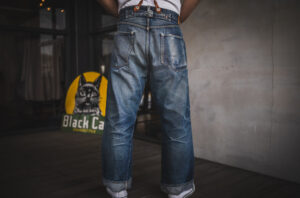
This is how the 20’s Jeans turned out after a year and a half of wear.
All of this was about eight years ago now.
Even today, I think the fading is absolutely incredible.
There was also one particularly interesting change.
Perhaps because I never used synthetic detergent, the denim developed a distinct yellowish cast.
I cannot scientifically determine exactly what caused it.
It may have been a combination of body oils, perspiration, soap residue and other factors.
But to me, this slightly imperfect, “not-too-clean” colour comes remarkably close to the atmosphere I find in pre-war vintage denim.
The beauty of ageing denim is not only found in the contrast between different shades of blue.
I hope you will also appreciate this yellowing and muted, dusty character as part of what makes pre-war denim so fascinating.







 Categolies
 Tag
Tag Archive